

A Case Study in Modern Lawfare
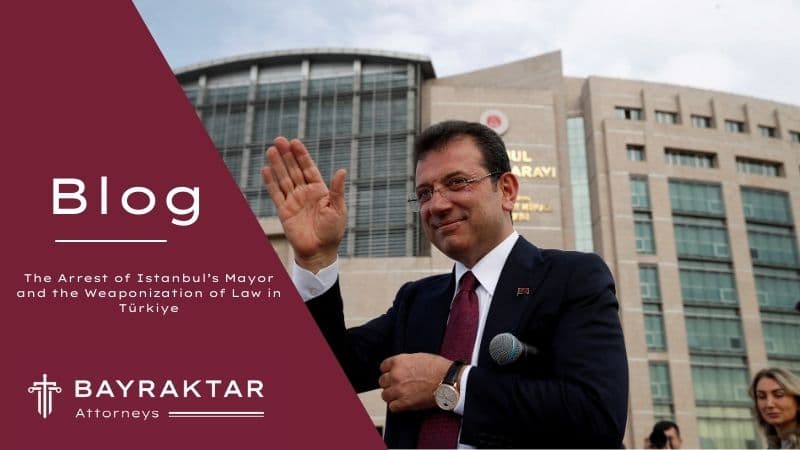
On March 19, 2025, Turkish police arrested Istanbul Mayor Ekrem İmamoğlu on allegations of corruption and aiding a terrorist organization. Four days later, on March 23, a criminal court ordered his pre-trial detention.
From a purely procedural standpoint, these events might appear as part of an ordinary criminal process. From a constitutional and comparative law perspective, however, the case bears all the hallmarks of lawfare: the strategic use of legal mechanisms to neutralize political opposition while maintaining a façade of legality.
İmamoğlu is not only the elected mayor of Türkiye's largest city; he is also widely regarded as the most viable opposition candidate capable of challenging President Erdoğan in a future presidential election. This political context is essential. Lawfare does not operate in isolation from politics; it weaponizes legal tools precisely because they carry institutional legitimacy.
This article examines the İmamoğlu case through a legal lens, focusing on three defining characteristics of the lawfare strategy used against him:
multi-front, multi-purpose, and multi-actor enforcement, followed by a discussion of clear violations of fundamental legal principles under Turkish and international law.
Lawfare as a Multi-Front Strategy
One of the most striking aspects of the case is the sheer volume of legal proceedings targeting İmamoğlu simultaneously. These include:
A criminal conviction (currently under appeal) sentencing him to over 2.5 years in prison for allegedly insulting members of the High Election Council, despite the absence of named individuals or institutions and the court's reliance on inferred intent.
Criminal charges for allegedly threatening public officials involved in counter-terrorism activities, based on political criticism of the Istanbul Chief Public Prosecutor.
Additional charges for allegedly attempting to influence a judicial officer, stemming from public remarks questioning the neutrality of an expert witness repeatedly appearing in cases against him.
An administrative decision by Istanbul University revoking his university diploma decades after issuance, on grounds that the institution itself had previously approved.
To this already expansive list were added corruption and terrorism-related allegations tied to the so-called "City Consensus" initiative, a political coordination effort among opposition parties during the 2024 local elections.
From a legal strategy perspective, this approach reflects deliberate procedural saturation. Each case alone might fail. Collectively, they exhaust financial resources, dominate media narratives, and keep the target in a constant defensive posture. In comparative constitutional studies, this tactic is often described as "procedural strangulation."
Lawfare as a Multi-Purpose Tool
Each legal action against İmamoğlu serves a distinct legal consequence, demonstrating that the objective is not justice but political incapacitation.
Disqualification from presidential candidacy:
Under Article 101 of the Turkish Constitution, presidential candidates must hold a university degree. The diploma revocation directly targets this requirement.Removal from elected office:
Article 47 of the Municipal Law authorizes the Minister of Interior to suspend mayors under investigation for corruption-related offenses. Following İmamoğlu's detention, his removal was announced the same day.Long-term political neutralization:
Criminal convictions, even if later overturned, may function as lasting political stigma.
From a rule-of-law standpoint, this represents a functional collapse of the principle of proportionality. Legal tools intended for exceptional circumstances are deployed cumulatively to ensure exclusion from democratic competition.
Lawfare as a Multi-Actor Enterprise
Lawfare of this scale requires institutional coordination. In the İmamoğlu case, multiple actors appear to have functioned in alignment:
Pro-government media outlets disseminating unverified allegations.
The Financial Crimes Investigation Board (MASAK), operating under the Ministry of Treasury, generating financial reports later criticized by investigative journalists.
Law enforcement authorities conducting extended interrogations based on these reports.
Prosecutors pursuing charges with limited evidentiary substantiation.
Judges issuing detention orders with minimal legal reasoning.
From a constitutional perspective, this raises serious concerns about institutional independence, particularly judicial independence as guaranteed under Article 138 of the Turkish Constitution and Article 6 of the European Convention on Human Rights (ECHR).
The Illegality Behind the Façade
Lawfare does not require legality; it requires procedural appearance. Several actions in this case appear plainly unlawful:
1. Diploma Revocation
Under Turkish administrative law, revocation authority lies with the issuing faculty board, not the university administration at large. Numerous administrative law scholars have publicly stated that Istanbul University acted ultra vires.
2. Pre-Trial Detention Without Reasoned Judgment
Pre-trial detention under Turkish law requires:
Concrete facts establishing strong suspicion, and
Specific grounds such as flight risk or evidence tampering.
The detention decision relied on abstract assumptions, such as:
Classification of offenses as "catalog crimes"
The severity of statutory penalties
Generalized assertions of flight risk
Under both Turkish procedural law and ECHR jurisprudence, abstract reasoning is insufficient. Courts must demonstrate individualized, evidence-based necessity. Defendants subjected to such orders can, in principle, pursue the established route to challenge detention in Turkey by filing an appeal against the arrest.
3. Selective Enforcement
Perhaps most damaging to legal credibility is unequal application. While opposition figures face aggressive prosecution, credible corruption allegations involving ruling-party officials remain uninvestigated. Simultaneously, political engagement with legally operating parties is criminalized for the opposition while peace negotiations with designated terrorist organizations proceed at the state level.
This violates the principle of equality before the law, a cornerstone of any constitutional system.
Broader Legal Implications for Türkiye
The İmamoğlu case is not merely a political scandal; it is a jurisprudential warning sign. When courts abandon reasoned judgment, legal certainty collapses. When pre-trial detention becomes punitive rather than preventive, criminal procedure transforms into political punishment.
Even successful appeals to the Constitutional Court or the European Court of Human Rights may take years, during which the political objective has already been achieved. In this environment, choosing the right type of lawyer in Türkiye becomes critical for anyone navigating politically charged proceedings.
Beyond Courts: Law, Society, and Democratic Resistance
Legal remedies remain essential, but they are increasingly insufficient on their own. Peaceful assembly, political organization, and economic pressure have historically played critical roles in resisting democratic erosion. These are not alternatives to law but complements when law is captured.
Final Remarks
At Bayraktar Attorneys, we view the İmamoğlu case as a textbook example of how law can be repurposed against democracy while maintaining institutional formality. Understanding these mechanisms is essential not only for Turkish citizens but also for foreign investors, diplomats, academics, and international organizations assessing legal predictability in Türkiye.
The strength of a legal system is not measured by the number of cases it produces, but by the quality, neutrality, and reasoning of its judgments. When those collapse, the consequences extend far beyond a single defendant.